
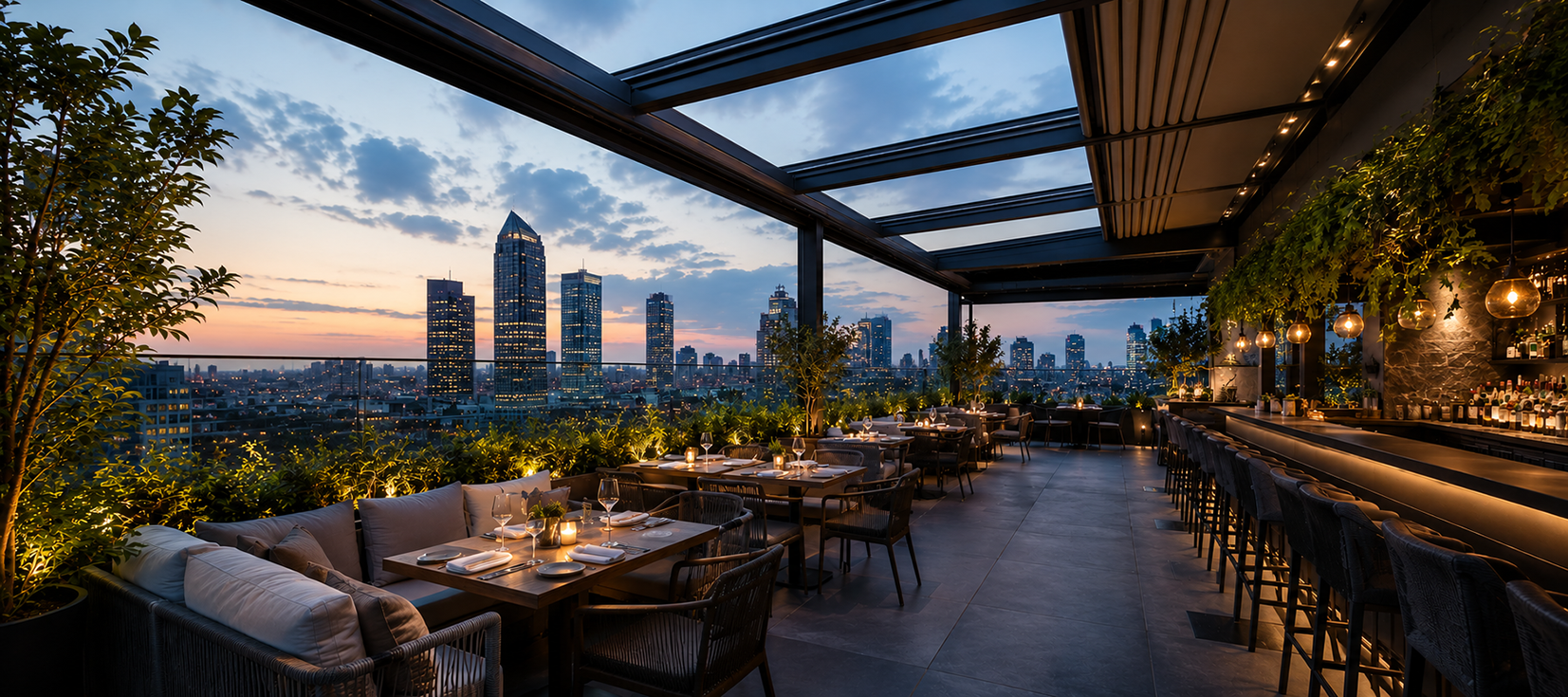
Yes — retractable roofs are often highly suitable for rooftop restaurants because they allow venues to maximise seating capacity, improve year-round usability, protect customers from unpredictable weather, and create a more flexible hospitality space without fully enclosing the rooftop.
For many hotels and restaurants, retractable roofing systems help rooftop dining areas remain fun across more of the year, particularly in cities with highly variable weather that can change rapidly throughout the week.
According to UK Hospitality, weather resilience and outdoor space optimisation have become increasingly important for hospitality operators since the pandemic-era shift toward outdoor dining. Meanwhile, guidance from the Health and Safety Executive also highlights the importance of managing weather exposure, ventilation, and safe occupancy within commercial environments.
What Should Rooftop Restaurants Consider Before Installing a Retractable Roof?
Wind Exposure
Rooftop environments are exposed to significantly stronger winds than ground-level hospitality spaces.
Important considerations include:
- Wind resistance ratings
- Automated closure systems
- Drainage management
- Secure framework installation
Planning Permission and Regulations
Depending on the project, restaurants may require:
- Planning permission
- Building regulations approval
- Fire safety compliance
- Licensing considerations
This is particularly relevant in conservation areas or dense urban environments.
Guidance from the Planning Portal can help businesses understand whether planning approval may be required.
Why Are Retractable Roofs Popular in Rooftop Restaurants?
Rooftop restaurants face a unique challenge: customers want open-air dining experiences, but operators still need weather protection and reliable trading conditions.
Retractable roofs help bridge that gap.
Key Benefits of Retractable Roof Systems
| Benefit | Why It Matters |
| Weather protection | Allows service during rain, wind, or strong sun |
| Increased annual revenue | Extends usable trading periods across more seasons |
| Better customer experience | Offers open-air dining when conditions are good |
| Flexible atmosphere | Venue can transition from daytime to evening settings |
| Improved space utilisation | Makes rooftop areas commercially practical year-round |
How Do Retractable Roofs Improve Rooftop Dining?
They Make Spaces Viable All Year Round
One of the biggest advantages is maximising how often a rooftop space can be used. In the UK, uncovered rooftop areas may only operate comfortably for a few months of the year. Retractable roofing systems can dramatically increase usable days by protecting diners from:
- Rain
- Wind chill
- Excessive sun exposure
- Sudden weather changes
Rain is an especially important consideration as, per the Met Office, most regions in the UK experience measurable rainfall on at least 100 days a year, and any time you cannot use a space in a commercial setting, you’re effectively losing money. A retractable roof paired with patio heaters can make a space useable all year round.
Are Retractable Roofs Better Than Permanent Roof Structures?
Yes, for restaurants, retractable roofs are much better. Permanent roofing systems provide protection but remove much of the open-air appeal that makes rooftop dining attractive in the first place. Retractable systems allow restaurants to adapt conditions depending on:
- Weather
- Temperature
- Events
- Time of day
- Customer demand
Warm and sunny days can often feel like a rarity in the UK, and maximising the enjoyment of every one of these days is
Retractable Roof vs Permanent Roof
| Feature | Retractable Roof | Permanent Roof |
| Open-air capability | Yes | No |
| Weather protection | Yes | Yes |
| Flexibility | High | Low |
| Natural ventilation | Better | Limited |
| Seasonal adaptability | Excellent | Moderate |
| Rooftop ambience | Preserved | Reduced |
What Types of Retractable Roofs Are Used in Rooftop Restaurants?
Several retractable roof systems are commonly used within commercial hospitality environments.
Common Rooftop Restaurant Roof Systems
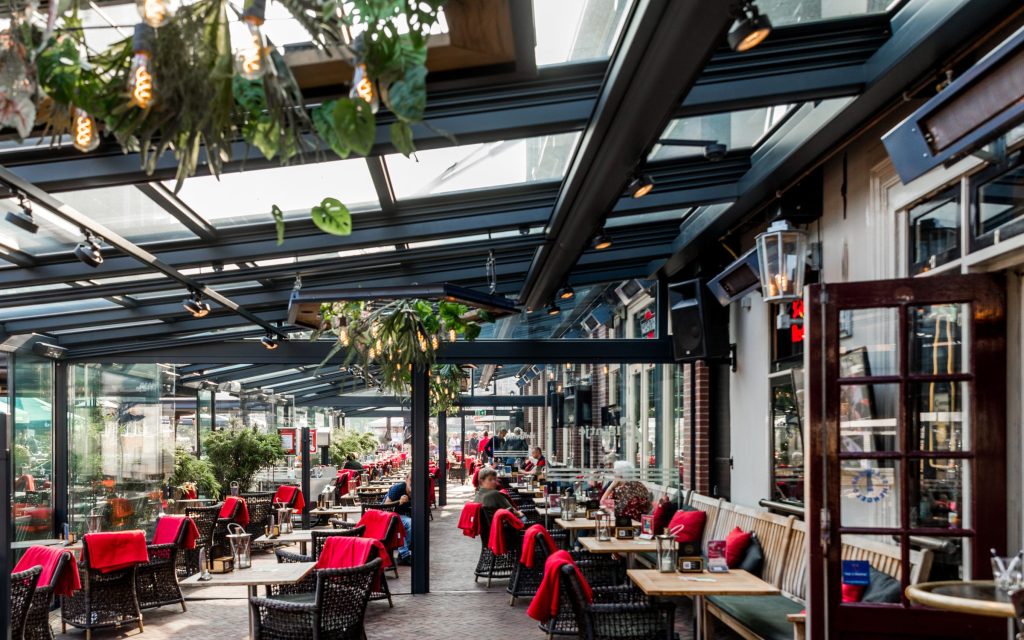
Retractable Glass Roofs
Popular in premium rooftop venues where visibility and aesthetics are important.
Benefits include:
- Natural light retention
- Luxury appearance
- Rain protection
- Wind shielding
Fabric Retractable Roofs
Often used in larger outdoor hospitality spaces.
Benefits include:
- Lower structural weight
- Large coverage areas
- Faster installation
- Contemporary appearance
Louvre Roof Systems
Motorised aluminium louvre systems are increasingly common in rooftop hospitality projects.
Benefits include:
- Adjustable airflow
- Sunlight control
- Modern appearance
- Integrated drainage options
Are Retractable Roofs Energy Efficient?
They can be. Modern retractable roofing systems can improve energy performance by helping regulate:
- Solar gain
- Ventilation
- Heat retention
- Airflow management
When combined with side glazing, heating systems, or automated climate controls, retractable roofs can help reduce reliance on artificial heating and cooling during moderate conditions.
The Carbon Trust has repeatedly highlighted the importance of passive ventilation and adaptive building design in improving commercial energy efficiency by, among other things, reducing the need for fans and air conditioning units to be running.
Do Retractable Roofs Increase Revenue for Rooftop Restaurants?
In many cases, yes.
A rooftop dining space that can only operate reliably during ideal weather conditions will probably remain unused for most of the year in the UK.
Retractable roofs help restauranteurs:
- Increase booking reliability
- Reduce weather-related cancellations
- Host private events year-round
- Improve customer comfort
- Maximise seating availability
For high-rent city-centre hospitality venues, improving utilisation of rooftop square footage can significantly improve return on investment.
Frequently Asked Questions
Are retractable roofs waterproof?
Yes – this is the main point of them. Most commercial retractable roof systems are designed to provide effective rain protection when closed. High-quality systems typically include integrated drainage channels and weather seals.
Can retractable roofs withstand strong winds?
Commercial-grade systems are generally engineered for high wind resistance, although suitability depends on building height, location, and system specification.
Do rooftop restaurants need planning permission for retractable roofs?
Not usually, requirements vary depending on the building, location, conservation status, and scale of the installation.
Are retractable roofs expensive?
Costs vary significantly depending on factors like complexity of mechanisms, material used and size.
However, many hospitality businesses view them as a long-term investment in usable trading space.
Final Thoughts
Retractable roofs are often an excellent solution for rooftop restaurants because they preserve the appeal of outdoor dining while improving weather resilience, operational flexibility, and year-round commercial viability.
For hospitality venues looking to maximise rooftop usage without fully enclosing the space, retractable roofing systems can offer a strong balance between aesthetics, practicality, and customer experience.