
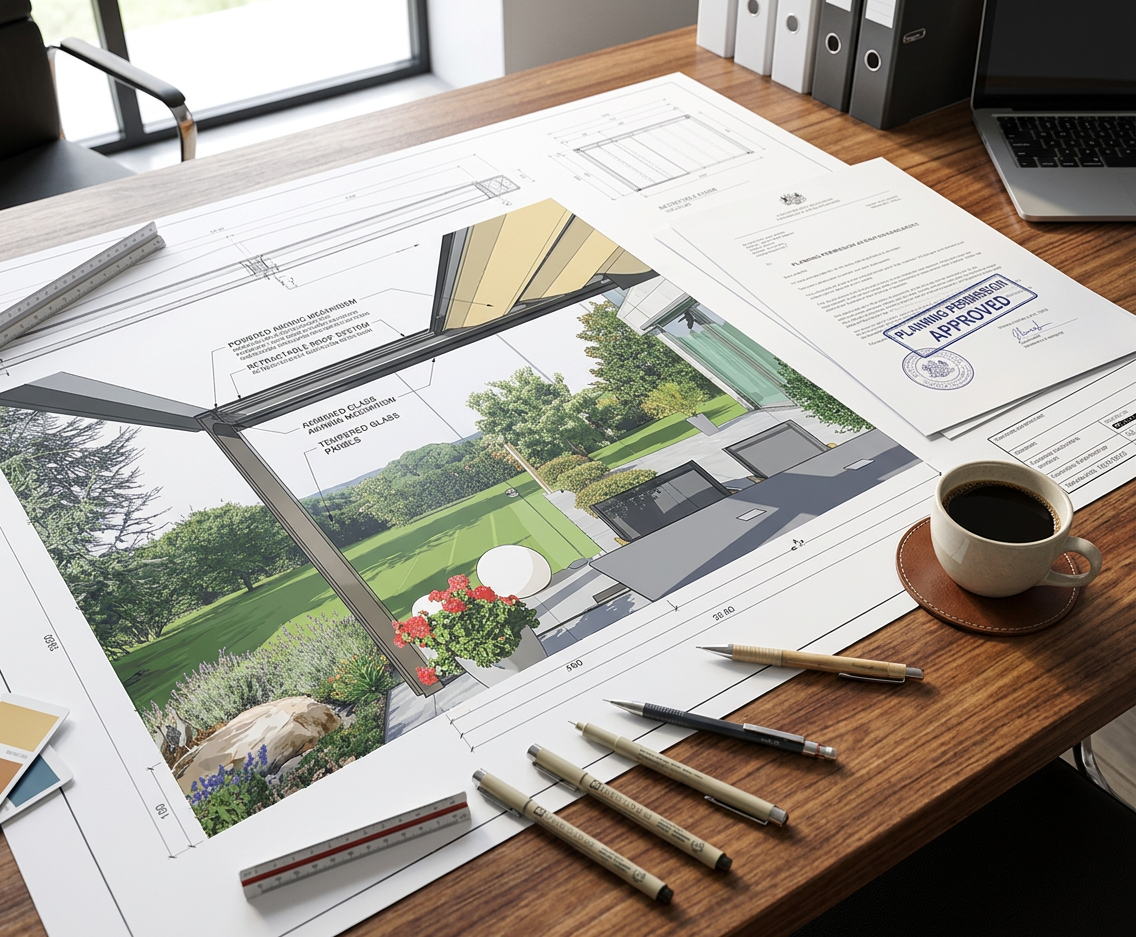
A pergola can be a wonderful addition to your garden, but many people are put off because they assume there will be a need to apply for planning permission and fill out paperwork for permission to erect the structure. However, the good news is that for most domestic, garden pergolas you don’t need to apply for planning permission; instead they are covered under the UK permitted development rights.
Planning Permission for a Retractable Pergola – Key Summary
- Boundary Proximity & Height – If placed within 2 metres of a boundary fence/wall, the maximum overall height cannot exceed 2.5 metres. Beyond 2 metres, height can go up to 3 metres for louvred or flat roofs.
- Ground & Base Rules – Height must be measured from the highest natural ground level. Any raised patio or decking base built under the structure must not exceed 0.3 metres.
- Land Coverage – The pergola, combined with all other outbuildings and extensions cannot cover more than 50% of the land surrounding the original house.
- Location – It must be placed in the rear or side garden—never in front of the house’s main front facade (principal elevation).
A Look at Permitted Development Guidelines
Whilst most retractable pergolas do fall under permitted development guidelines, it is important to understand exactly what these guidelines are. That way, you can be sure that your choice of pergola installation meets the requirements. If your project falls outside of these, then this may trigger a need to apply for planning permission. If you are ordering a retractable pergola from us, then we would be more than happy to guide you through this and make sure you don’t fall foul of any rules.
The first thing to remember is that permitted development only covers pergolas for domestic use and they cannot be installed at the front of the property. It doesn’t cover commercial properties, flats or maisonettes. Your chosen pergola cannot cover more than 50% of the land surrounding the original house.
It can only be used as a temporary structure and not used for self-contained living. There are also height restrictions. It can be no taller than:
- 2.5m (8.2ft) if within 2m (6.6ft) of a boundary
- 4m (13.1ft) maximum for a dual-pitched roof
- 3m (9.8ft) maximum for any other roof type
It is also worth keeping in mind that any additions to your pergola will need to comply with Building Regulations. For example, a motorised retractable pergola with integrated heating or lighting must comply with UK electrical/safety regulations, even if exempt from planning permission.
As a side note, although rare, some local councils issue an “Article 4 Direction” in specific streets or neighbourhoods, which removes Permitted Development rights entirely (common in urban London boroughs or historic towns). It is vital that you check this before assuming exemption.
What Makes a Retractable Pergola So Good?
The UK weather is unpredictable. We’ve just come out the other side of a heatwave, but today it is far too wet and windy to sit outside. A well installed, high-quality retractable pergola allows you to make much better use of your outdoor space. Whether you want coverage from the rain, some shade from the sun or just a slight roof to offer a little shade, the right pergola will be able to do it all. Made from high-quality durable material you’ll find that the right type of pergola will last you many years and with minimum maintenance needed.
When Would I Need Planning Permission for a Pergola?
Whilst it is true that most domestic pergolas are covered by permitted development, there are some scenarios where this doesn’t count. If that is the case then you will need to apply for planning permission before you go ahead with the installation of your retractable pergola. We’ll always be on hand to guide you and ensure you apply for planning permission if this is required. Scenarios where this might be the case include:
- A pergola installed at the front of the property.
- Your pergola is intended for commercial use.
- You already have or this will cause you to have more than 50% of the land around the original house covered in extensions and/or outbuildings.
- Your pergola is taller than the height restrictions listed under permitted development rules
- You live in a listed building or within a conservation area, national park, or AONB.
- You live in a flat or a maisonette.
How To Get Started
If you are considering a pergola, then the first thing you are going to want to do is make sure that you are investing in the right set-up for you and your needs. We’d recommend having a browse of our website and a read of our blog to get yourself up to date with the options that are out there. Have a chat to our friendly team about your personal preferences, the space you have available and your budget and we’ll work with you to come up with a retractable pergola option that suits.
Pergola Planning Permission FAQs
What is the maximum height for a pergola without planning permission in the UK?
- Within 2 metres of a boundary – Maximum height is 2.5 metres (measured from natural ground level).
- More than 2 metres from a boundary – Maximum height is 3.0 metres for flat or louvred roofs (or up to 4.0 metres for dual-pitched roofs).
Do retractable pergolas count towards the 50% garden coverage limit?
Yes. Under UK planning rules, all garden outbuildings, sheds, extensions, and pergolas combined cannot cover more than 50% of the curtilage (the land area surrounding the original house, excluding the area taken up by the original house itself).
Does adding glass side panels or heaters change the planning status?
Adding removable screens or light heaters usually keeps the structure within Permitted Development. However, adding fixed glass walls, solid side enclosures, or heavy structural alterations moves the canopy closer to an “extension” or “conservatory” classification, which may trigger formal planning permission and Building Regulations approval.